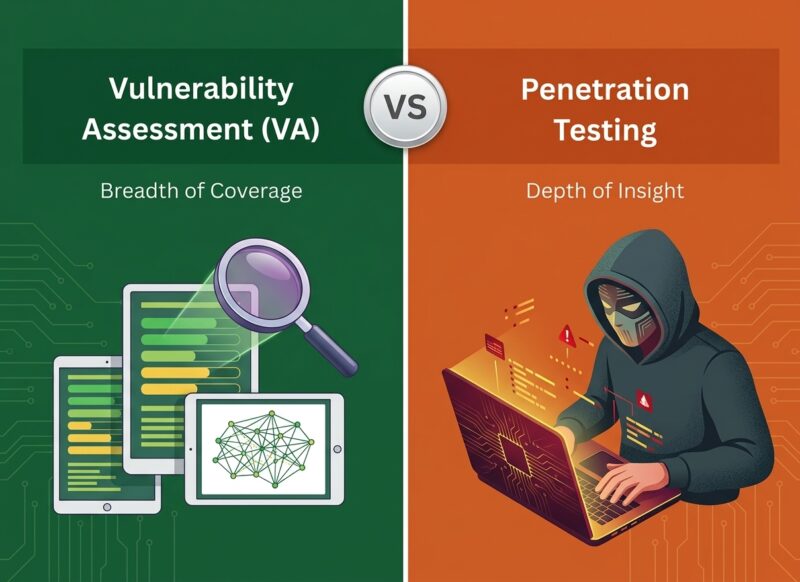
Web Vulnerability Assessment vs Penetration Testing: How to Tell the Difference
Not all web security assessments provide the same level of assurance. A Web Vulnerability



Network VAPT (Vulnerability Assessment & Penetration Testing) is a proactive security assessment that identifies vulnerabilities across your corporate network before attackers can exploit them.
Rather than relying solely on configuration reviews, we assess your infrastructure from an attacker’s perspective to uncover real-world security weaknesses.
Our assessments cover both on-premise and cloud environments, including servers, network devices, virtual machines, VPNs and remote access infrastructure.
Depending on your requirements, we can perform:
Simulates an Internet-borne attack targeting your public-facing infrastructure, cloud environments, public IP ranges, firewalls and exposed corporate services to exploit perimeter weaknesses and gain unauthorized foothold.
Key areas assessed:
Operates inside your perimeter walls, evaluating what an attacker, rogue device or compromised account can achieve once inside the network boundary by simulating lateral movement to critical servers.
Key areas assessed:

Licensed by CSA under CSRO and onboarded as a CISOaaS VAPT provider, ensuring accountability and regulatory compliance.
Licence No CS/PTS/C-202606-336

Our consultants hold industry certifications including CREST, CISSP and AWS, backed by over 20 years of practical cybersecurity and infrastructure experience.

Standard pentests show what breaks. Positive Attestations show what held — backed by execution logs and evidence, providing strong proof for your auditors.
Yes, eligible SMEs can apply for CISOaaS VAPT grant of up to 70%, cap at endpoint tier.
More details here.
Technically, any organization connected to the Internet requires a Network VAPT—it is the foundational baseline compliance auditors look for first. Today, this requirement spans both your physical office footprint and your modern cloud architecture:
External VAPT: Essential if you run internet-facing services (VPN gateways, remote desktops, email portals) to defend your outer perimeter against public threats.
Internal & Hybrid VAPT: Crucial if you host staff-accessible assets like local Active Directories and core databases, plus private cloud workloads sitting inside isolated VPCs.
The Hybrid Reality: Even if your cloud servers lack public IP addresses, they are not immune. An attacker gaining an initial foothold via phishing or a compromised employee device can easily move laterally into your private cloud subnets. Modern Network VAPT must evaluate on-premise infrastructure and private cloud networks as a single, unified architecture to eliminate these dangerous blind spots.
External penetration test is the right starting point if you haven’t tested before, or whenever your internet-facing footprint changes — new cloud deployments, opening a new office, acquiring a company, or launching a new service.
An internal penetration test is essential if your organization hosts critical assets—such as Active Directory, core databases, or high-value servers—whether they sit on-premise or in the cloud. This assessment becomes critical immediately following a phishing incident or credential breach, after making significant changes to your network infra, or when you need to validate secure network segmentation between zones. Ultimately, mature organizations run both external and internal penetration tests annually: external to harden the perimeter, and internal to drastically limit the blast radius if that perimeter ever fails.
Our Vulnerability Assessment uses automated Nessus scanning to identify potential security gaps, which our team manually reviews to eliminate false positives.
A Penetration Test goes a step further by actively simulating real-world exploits to prove exactly how far an attacker could breach your defenses.
Choose a vulnerability assessment if you need a cost-effective network security scan to identify missing patches, eliminate false positives, and maintain baseline security hygiene. Opt for a network penetration test if you need to satisfy compliance standards (like MAS TRM, PCI) and want to see how real-world exploits could impact your business assets. For the best defense, use regular automated scans to find network weaknesses and an annual penetration test to validate your actual security posture against human adversaries.
No. We focus heavily on safe exploitation methods. All intrusive actions are mapped and scheduled precisely with your IT stakeholders beforehand. Our engineers continuously monitor target response metrics to preserve zero-downtime operational bounds.
Our report consists of:
Not all web security assessments provide the same level of assurance. A Web Vulnerability
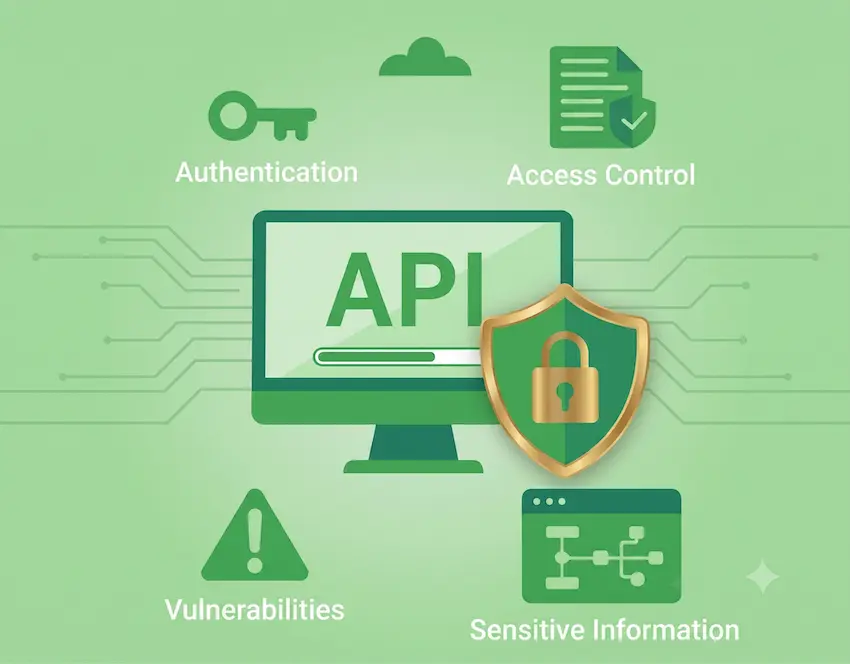
Modern web applications increasingly use Single Page Application (SPA) architectures, where the browser communicates

AI-powered chatbots and conversational assistants are becoming increasingly common in websites and business applications.