
Your web application passed a penetration test two years ago. Does that mean it is still secure today?
Not necessarily.
AI is changing how attackers discover vulnerabilities, analyse applications and automate attacks. Activities that once required significant technical expertise and manual effort can now be accelerated with AI-assisted tools.
For organisations running legacy web applications, this raises an important question: Are your existing security controls and previous penetration test results still sufficient to protect your application against today’s threats?
It may be time to reassess your web application security.
1. AI Is Making Cyberattacks Faster and More Scalable
Traditionally, attackers needed time and technical expertise to identify targets, investigate vulnerabilities and develop ways to exploit them.
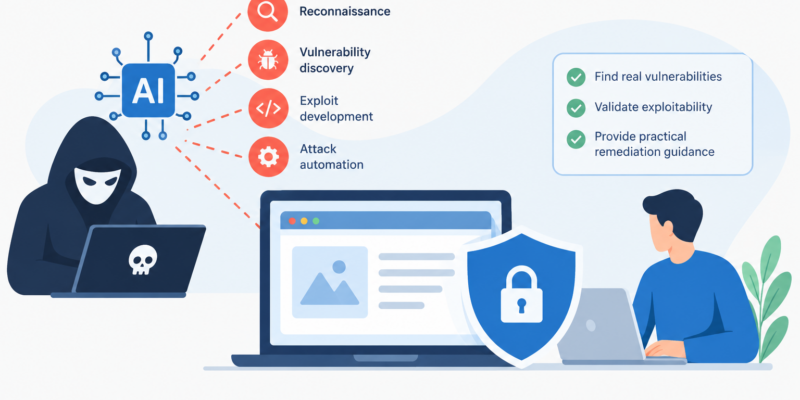
AI can help accelerate these activities, including:
- Reconnaissance: Identifying exposed systems and potential entry points.
- Vulnerability discovery: Analysing applications and code for weaknesses.
- Exploit development: Helping attackers investigate and adapt exploitation techniques.
- Attack automation: Scaling reconnaissance and other attack activities across multiple targets.
This does not mean AI can automatically hack every website. However, it can lower the effort required to investigate potential targets and help attackers work more efficiently.
Applications that were previously difficult or time-consuming to assess may become more attractive targets.
2. Why Legacy Web Applications May Be at Risk
Many organisations continue to rely on web applications developed before AI-assisted attacks became widespread. Over time, these applications may accumulate outdated components, new integrations and security assumptions that have never been thoroughly reassessed.
Common areas of concern include:
- Outdated software components with known vulnerabilities or inadequate security support.
- Access control weaknesses that allow users to access data or functions beyond their authorisation.
- Insecure APIs that expose sensitive data or business functions.
- Business logic flaws involving transactions, approval workflows or user privileges.
- Configuration weaknesses that expose unnecessary services or sensitive information.
Some vulnerabilities can be identified through automated scanning. Others require a tester to understand how the application works and investigate whether its functions can be abused.
The age of an application does not automatically make it insecure. The risk arises when weaknesses remain undiscovered or existing security assumptions are no longer valid.
3. Why Your Previous Penetration Test May No Longer Be Enough
A previous web application penetration test remains valuable. However, it only provides assurance about what was assessed, within the agreed scope and at that point in time.
Three factors make reassessment important.
Your application may have changed. New features, integrations, APIs and access control changes can introduce vulnerabilities that did not exist during the previous test.
Attack techniques continue to evolve. AI-assisted tools give attackers additional ways to investigate potential weaknesses and scale their activities.
Your previous test may not have covered everything. A penetration test is not necessarily an exhaustive examination of every endpoint, business function and attack path. If critical APIs or business logic were not adequately assessed, further targeted testing may be appropriate.
Fixing previously reported vulnerabilities is essential, but it does not establish that the application has no other weaknesses.
Passing a penetration test is not a guarantee of future security.
4. AI-Assisted Attacks Require More Than Automated Scanning
As attackers adopt AI, organisations may respond by relying more heavily on automated security tools. While these tools are useful, automated scanning alone cannot provide complete assurance.
For example, a scanner may identify an outdated library or a missing security header. But determining whether a user can bypass an approval workflow, access another customer’s records or manipulate a transaction may require deeper investigation.
Effective penetration testing combines automated tools with manual testing, business logic analysis and validation of potential vulnerabilities.
AI can help accelerate security analysis, but findings must still be validated to establish whether they are exploitable and what impact they could have.
The objective is not simply to find more vulnerabilities. It is to identify the weaknesses that matter and provide practical guidance to address them.
5. Reassess Your Web Application Security
If your web application has not undergone a comprehensive security assessment recently, consider the following steps:
- Review your previous pentest report. Check the assessment date, scope, limitations and outstanding findings.
- Review changes to your application. Identify new features, integrations, APIs and changes to security controls.
- Prioritise critical functions. Pay particular attention to access controls, sensitive data, authentication and important business transactions.
- Conduct a security reassessment. Arrange a fresh web application penetration test or targeted API penetration test where appropriate.
- Validate remediation. Confirm that identified vulnerabilities have been addressed effectively.
The aim is to understand your application’s current security posture, rather than relying solely on findings from a previous assessment.
6. AI-Augmented, Human-Led Penetration Testing
At Perennial Consultancy, we believe penetration testing must evolve alongside the threats it is designed to uncover.
Our approach combines AI-assisted analysis with human-led penetration testing to identify meaningful vulnerabilities, validate exploitability and provide practical remediation guidance.
AI helps accelerate security analysis, but human expertise remains essential for investigating business logic, assessing real-world impact and distinguishing exploitable vulnerabilities from false positives.
A penetration test should deliver more than a list of potential weaknesses. It should help you understand which issues matter, how they affect your application and what you can do to address them.
Whether you operate a legacy web application or a modern application with multiple APIs, a fresh security assessment can help uncover weaknesses that previous testing may not have identified.
Eligible SMEs Can Offset Up to 70% of Web VAPT Costs
Perennial Consultancy’s web application penetration testing service is available under the CSA CISO-as-a-Service (CISOaaS) VAPT programme.
Eligible Singapore SMEs may be able to offset up to 70% of the assessment cost through the programme, subject to prevailing eligibility criteria and funding terms.
This provides an opportunity for eligible businesses to reassess their web application security and address potential vulnerabilities with reduced financial 부담.
Is Your Web Application Ready for the AI Era?
Attackers are evolving their methods. Organisations should reassess their defences accordingly.
If your application was developed before the widespread adoption of AI, or if it has not undergone a comprehensive security assessment recently, consider reviewing its current exposure and identifying areas that warrant further testing.
Don’t rely solely on what your last penetration test found. Reassess what an attacker could exploit today.
Explore Perennial Consultancy’s Web and API Penetration Testing services to discuss your requirements and check your eligibility for the CSA CISOaaS VAPT programme.