

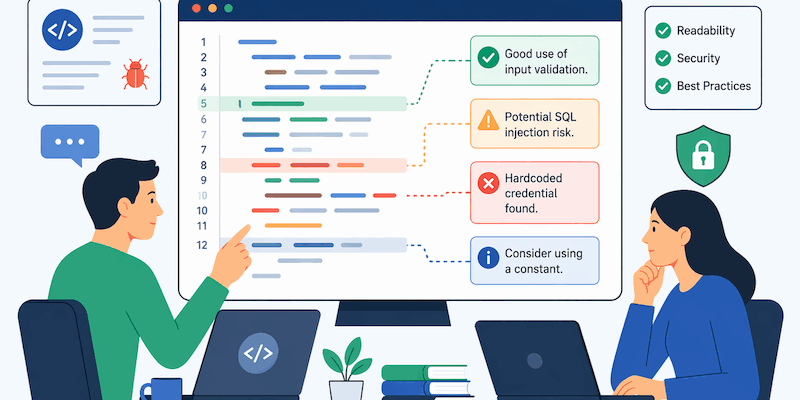
For many organisations, code review has traditionally been seen as something “nice to have.”
A practice reserved for:
- Large enterprises
- Government projects
- High-assurance systems
For everyone else—especially fast-moving teams—it was often skipped in favour of speed.
That trade-off is becoming increasingly dangerous.
AI Has Changed How Vulnerabilities Are Found
The way vulnerabilities are discovered today is fundamentally different from just a few years ago.
With AI-assisted tools, attackers can:
- Analyse code patterns at scale
- Identify potential weaknesses faster
- Generate exploit variations rapidly
This is especially true for APIs and modern applications, where:
- Attack surfaces are larger
- Logic is more complex
- Changes are deployed frequently
The result is simple:
Vulnerabilities are being discovered faster than organisations can remediate them.
The Open-Source Reality Most Teams Overlook
Most modern applications are not built from scratch.
They are assembled from:
- Open-source libraries
- Frameworks
- Third-party components
In many cases, over 70–80% of an application’s codebase is not written in-house.
This creates a hidden risk.
Why Open Source Is Riskier Than Before
Open source is powerful—but in today’s environment, it also comes with growing risks.
1. Attackers Have the Same Visibility as You
Open-source code is publicly available.
This means:
- Attackers can study it in detail
- Analyse logic and edge cases
- Identify weaknesses before they are widely known
With AI, this process is now significantly faster and more scalable.
2. Maintainers Are Often Resource-Constrained
Many widely used libraries are:
- Maintained by small teams
- Or even individual contributors
These maintainers may:
- Lack time for thorough security reviews
- Prioritise functionality over security hardening
- Struggle to respond quickly to newly discovered issues
3. Community Contributions Introduce Uncertainty
Open source thrives on community contributions—but that also introduces risk.
You often do not know:
- Who contributed a piece of code
- Whether it has been rigorously reviewed
- If subtle malicious logic has been introduced
While most contributions are legitimate, the model relies heavily on trust.
4. Supply Chain Attacks Are Increasing
Attackers are no longer just targeting applications—they are targeting the software supply chain.
Examples include:
- Compromised packages
- Malicious updates
- Dependency confusion attacks
Instead of attacking one company, attackers compromise a library and gain access to many.
5. Dependency Chains Are Deep and Opaque
A single library may depend on dozens of others.
This creates:
- Layers of indirect dependencies
- Limited visibility into what is actually running in your environment
Even if your direct dependencies are secure, transitive ones may not be.
Why Code Review Is Becoming Critical
Traditional vulnerability scanning tools are useful—but they have limits.
They typically:
- Detect known vulnerabilities (CVEs)
- Rely on signatures and patterns
- Miss business logic flaws
They do not fully answer:
- Is the logic secure?
- Are there unintended access paths?
- Is sensitive data handled correctly?
This is where code review becomes essential.
What Code Review Actually Provides
A proper code review helps to:
- Identify logic flaws that scanners miss
- Validate authentication and authorization flows
- Detect insecure use of libraries and APIs
- Spot risky patterns before they are exploitable
It shifts security earlier in the lifecycle, before issues reach production.
From “Luxury” to “Baseline”
In the past, code review was seen as:
A high-cost, high-effort exercise reserved for critical systems.
Today, the equation has changed.
With:
- Faster attack cycles
- Widespread use of open source
- AI-assisted vulnerability discovery
Code review is no longer optional.
It is becoming a baseline security control.
Final Thoughts
Speed is often prioritised in modern development.
But in an AI-driven threat landscape, speed without assurance creates risk.
Code review provides that assurance.
Not as a replacement for VAPT—but as a complementary layer that:
- Strengthens your foundation
- Reduces exploitable weaknesses
- Improves overall security posture
~ ~ ~ ~ ~ ~ ~ ~ ~ ~ ~
If you are considering code review or want to better understand your application’s security posture, drop us a message and we are happy to have a quick discussion.