
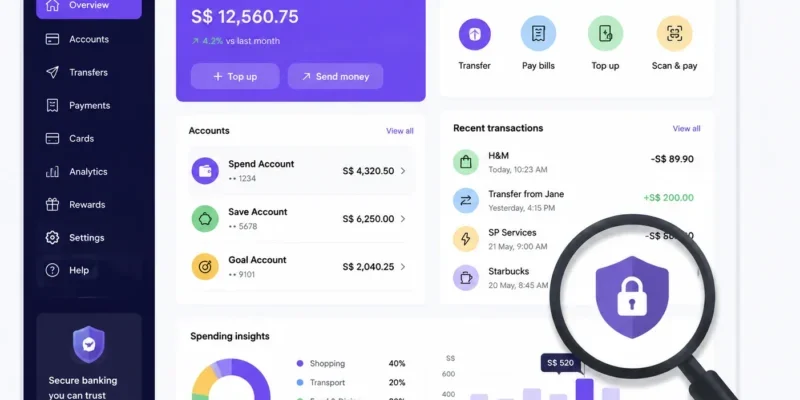
Every second, fintech platforms process high-value transactions, store sensitive financial data and connect with multiple third-party services through APIs. This makes them one of the most attractive targets for cybercriminals.
Unlike traditional web applications, fintech platforms aren’t just protecting customer information—they’re protecting money. A single weakness in access control, business logic or authentication can result in fraudulent transactions, financial losses or regulatory consequences.
Based on common vulnerability patterns identified during fintech penetration testing, here are the five most critical security issues that organisations should address.
1. Broken Object Level Authorisation (BOLA)
Why it happens
One of the most common API vulnerabilities occurs when an application verifies who you are, but fails to verify what you’re allowed to access.
Many payment APIs accept identifiers such as transaction IDs, beneficiary IDs or payment references supplied by the client. If the server does not verify that these objects belong to the authenticated user, an attacker can simply modify the identifier and gain access to another customer’s data.
Real-world impact
Imagine logging into your own banking portal and modifying a transaction ID in an API request. Instead of viewing your own payment, you suddenly gain access to another customer’s transaction—or worse, initiate actions against another account.
For multi-tenant fintech platforms, this is one of the highest-risk vulnerabilities because it completely breaks customer isolation.
How to prevent it
Every request must validate object ownership on the server before performing any action. Never rely solely on client-supplied identifiers or downstream verification such as OTPs or approval workflows.
2. Race Conditions in Financial Transactions
Why it happens
Financial transactions should only happen once.
However, some applications process multiple requests simultaneously without properly locking the underlying transaction. Attackers can exploit this tiny timing window by submitting several requests at exactly the same time.
Real-world impact
A single payment token, exchange-rate quote or promotional voucher may be processed multiple times before the database updates its status.
The result could include:
- Duplicate fund transfers
- Double withdrawals
- Multiple voucher redemptions
- Incorrect account balances
In payment systems, even milliseconds matter.
How to prevent it
Use atomic database operations, row-level locking or optimistic concurrency controls to ensure each transaction can only be processed once.
3. Business Logic Vulnerabilities
Why it happens
Not every vulnerability involves exploiting code.
Sometimes the application simply allows users to perform actions the business never intended.
Examples include expired exchange-rate quotes that remain valid, negative payment values, unlimited coupon usage or bypassing approval workflows.
Real-world impact
Attackers can exploit these flaws to lock in favourable exchange rates, manipulate pricing calculations or complete transactions outside intended business rules.
These attacks often bypass traditional security scanners because the application behaves exactly as programmed—it simply implements flawed business logic.
How to prevent it
Critical business rules should always be enforced on the server. Frontend validation improves user experience, but it should never be treated as a security control. Attackers rarely follow the intended user journey—they interact directly with backend APIs, bypassing client-side checks altogether.
4. Weak Authentication and User Enumeration
Why it happens
Login pages often reveal more information than developers realise.
Different error messages, response times or password reset behaviour may allow attackers to determine whether an account exists.
Without proper rate limiting, attackers can automate credential stuffing or password guessing against thousands of accounts.
Real-world impact
A successful enumeration attack provides attackers with a list of valid customer accounts, significantly increasing the success rate of brute-force and credential-stuffing attacks.
Combined with passwords leaked from previous data breaches, this can quickly lead to account compromise.
How to prevent it
- Return generic login error messages.
- Implement rate limiting and temporary account lockouts.
- Enforce multi-factor authentication (MFA).
- Monitor and alert on suspicious login activity.
5. Unrestricted File Upload
Why it happens
Most fintech platforms require customers to upload identity documents to satisfy Know Your Customer (KYC) requirements.
If uploaded files are not properly validated, attackers may disguise malicious files as PDFs or images.
Real-world impact
An unrestricted file upload vulnerability can allow attackers to:
- Upload web shells
- Execute malicious code
- Deliver malware to internal users
- Compromise backend infrastructure
A seemingly harmless document upload feature can quickly become an entry point for a full system compromise.
How to prevent it
Validate file signatures rather than file extensions, scan every uploaded file for malware, store files outside executable directories and process uploads within isolated sandbox environments.
Why Fintech Penetration Testing Matters
Fintech applications present a unique attack surface. Beyond common web application vulnerabilities, organisations must defend against API abuse, transaction manipulation, business logic flaws and identity-related attacks that directly impact financial assets.
Regular fintech penetration testing helps identify these weaknesses before attackers do. By assessing your web applications, APIs, mobile applications and supporting infrastructure, security teams can uncover exploitable vulnerabilities, strengthen customer trust and support compliance with regulatory frameworks such as the MAS Technology Risk Management (TRM) Guidelines.
Cybercriminals are continuously looking for weaknesses in fintech platforms. The best defence is to identify and remediate them before they become a costly security incident.
Looking to strengthen your fintech security? Explore our comprehensive VAPT packages to identify and remediate security vulnerabilities across your web applications, APIs, mobile applications and network infrastructure. If you’re a Singapore SME, you may also be eligible for the CSA-supported CISOaaS VAPT Grant, which provides funding support for eligible penetration testing engagements.