
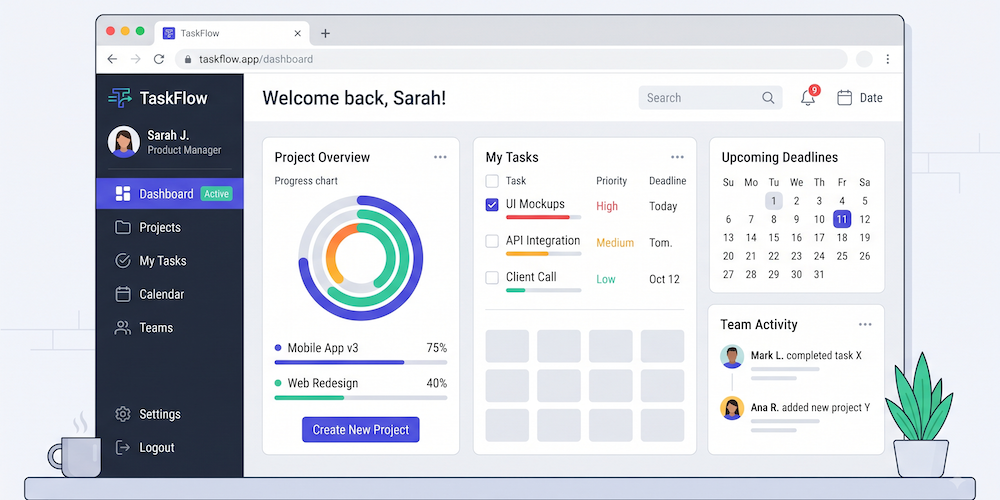
Single Page Applications (SPAs) have become increasingly popular for modern web applications. Frameworks such as React, Angular, and Vue allow developers to build fast, interactive applications that communicate extensively with backend APIs.
However, an SPA also introduces a different security attack surface.
Much of the application’s logic is handled by JavaScript running in the user’s browser, while the frontend communicates with backend APIs to retrieve and process data.
From a penetration testing perspective, this creates an important security principle:
The frontend should never be treated as a security boundary.
Attackers can inspect JavaScript, intercept API requests, modify parameters, and communicate directly with backend endpoints without following the intended user journey.
Based on common findings encountered during SPA penetration testing, here are five areas that deserve particular attention.
1. Broken Object Level Authorization (BOLA)
Broken Object Level Authorization (BOLA) occurs when an application fails to properly verify whether a user is authorized to access a specific object or resource.
This is particularly relevant to SPAs because they often rely heavily on APIs that reference objects such as:
- Customer records
- Transactions
- Accounts
- Orders
- Documents
- Invoices
A user may be properly authenticated but still be able to access another user’s resources if object-level authorization is not correctly enforced.
What can a penetration test uncover?
A penetration tester can assess whether users can access or modify resources belonging to other users by manipulating API requests and object references.
Key takeaway: Authentication confirms who the user is. Authorization determines what the user is allowed to access.
2. Client-Side Security Control Bypass
SPAs commonly implement validation and business rules in JavaScript.
For example, the frontend may restrict certain functions, fields, transaction limits, file types, or user actions.
However, anything enforced only in the browser can potentially be bypassed.
Attackers do not have to follow the intended user interface. They can interact directly with the backend APIs and modify requests.
What can a penetration test uncover?
Testing can identify whether security controls can be bypassed by manipulating:
- API requests
- Parameters
- Hidden functionality
- Frontend validation
- User roles
- Transaction workflows
Critical business rules should always be enforced on the server. Frontend validation improves user experience, but it should never be treated as a security control.
3. Insecure Direct Object Reference (IDOR)
Insecure Direct Object Reference (IDOR) occurs when an application exposes references to internal objects without properly verifying whether the requesting user is authorized to access them.
IDOR is closely related to BOLA and can affect resources such as:
- User profiles
- KYC documents
- Transactions
- Orders
- Reports
- Uploaded files
Using unpredictable identifiers such as UUIDs can make enumeration harder, but it does not replace proper authorization.
What can a penetration test uncover?
A penetration test can determine whether changing object identifiers or manipulating API parameters allows a user to access, modify, or delete another user’s resources.
4. Sensitive Information Exposure in JavaScript
SPAs deliver JavaScript code directly to the user’s browser.
This means attackers can inspect frontend resources to understand how the application works and how it communicates with backend services.
Information that may unintentionally be exposed includes:
- Internal API endpoints
- Debug information
- Development URLs
- Application configuration
- Feature flags
- Sensitive credentials or secrets
- Source maps containing application source code
Not everything found in JavaScript is a vulnerability. The concern is whether information that should remain confidential has been unnecessarily exposed.
What can a penetration test uncover?
A tester can review JavaScript bundles, source maps, configuration files, and other publicly accessible frontend resources to identify sensitive information that could assist an attacker.
Anything delivered to the browser should generally be considered accessible to the user.
5. File Upload Vulnerabilities
File uploads are common in modern SPAs, particularly for applications handling:
- KYC documents
- Identity documents
- Invoices
- Images
- Reports
- Attachments
Frontend restrictions such as allowed file extensions or file types should not be relied upon as the primary security control.
An attacker can bypass the frontend and interact directly with the upload endpoint.
What can a penetration test uncover?
A penetration test can assess whether the backend properly validates:
- File type
- File extension
- File content
- File size
- Filename handling
- Storage and access controls
Testing can also determine whether uploaded files can be accessed by unauthorized users.
Why SPA Penetration Testing Matters
The common theme across these vulnerabilities is simple:
Attackers do not have to use your application the way your developers intended.
A normal user may interact with:
Frontend → API → Backend
A penetration tester looks beyond the interface and asks:
- Can frontend restrictions be bypassed?
- Can API parameters be manipulated?
- Can another user’s data be accessed?
- Are sensitive resources properly protected?
- Is information unnecessarily exposed in JavaScript?
- Can uploaded files be abused or accessed by unauthorized users?
This is why simply scanning an SPA or testing it as a normal user may not be enough.
Manual penetration testing can uncover weaknesses in authorization, business logic, API security, and application functionality that automated tools may not identify.
How to Secure a Single Page Application
Organizations developing SPAs should follow several fundamental principles:
- Never trust the frontend — treat all client-side input as untrusted.
- Enforce authorization server-side — every API request should verify access rights.
- Protect individual objects — authentication alone does not provide authorization.
- Keep secrets out of JavaScript — frontend code should never contain confidential credentials.
- Validate file uploads server-side — do not rely solely on frontend restrictions.
- Test APIs independently — the backend should remain secure even when the frontend is bypassed.
Conclusion
Single Page Applications offer significant benefits for modern web development, but their API-driven architecture creates a unique security attack surface.
The key lesson is straightforward:
The frontend is not the security boundary.
Security controls must ultimately be enforced by the backend, where the application can independently verify authentication, authorization, input, and business rules.
If your organization operates a React, Angular, Vue, or other API-driven web application, a web application penetration test can help identify these weaknesses before they are discovered by attackers.
Learn more about our Penetration Testing Services
For eligible Singapore SMEs, you may also qualify for a CISOaaS VAPT grant supported by CSA, which can help offset eligible vulnerability assessment and penetration testing costs.