
Wireless networks are often the “soft underbelly” of an organization’s security posture. Because the signal extends beyond physical walls, an attacker doesn’t need to bypass a security guard to access your data—they just need to be in the parking lot or the lobby.
Before we dive into the technical flaws, let’s address who is most at risk and how to choose the right testing methodology.
Who Needs a Wi-Fi Pentest? (The Physical Risk)
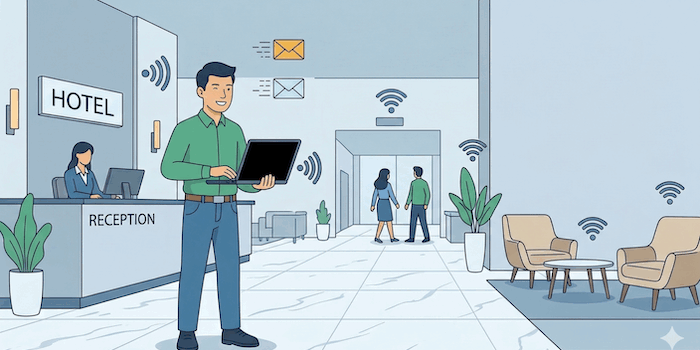
Beyond just “high-tech” industries, Wi-Fi security is a critical concern for any organization that operates a physical premise with high foot traffic. If your business allows people to come and go, your Wi-Fi signal is effectively a digital front door left unlocked.
-
Hospitality & Leisure (Hotels, Cafes, Gyms): These environments have hundreds of transient users daily. An attacker can sit for hours undisturbed, blending in while attempting to intercept guest data or hop from the “Guest Wi-Fi” to the hotel’s “Property Management System” (where credit card data lives).
-
Retail & Service Centers (Malls, Car Dealerships, Repair Shops): Places where customers wait often provide “Free Wi-Fi.” If this isn’t strictly isolated, a bored customer (or a malicious actor) could access the Point-of-Sale (POS) system or the shop’s internal inventory database.
- Co-working Spaces & Shared Offices: With different companies sharing the same airwaves, the risk of “cross-pollination” is high. If wireless networks are not properly secured and tested, sensitive corporate data from one organisation may be exposed to unauthorized parties operating within the same wireless space.
Choosing Your Strategy: Black Box vs. Grey Box
-
Black Box (Zero Knowledge): Choose this to simulate an External Threat. The tester arrives with no passwords or maps. This is the best way to see if your “hidden” networks can be found, if your guest portal can be bypassed, or if your encryption can be cracked by a stranger in the lobby.
-
Grey Box (Partial Knowledge): Choose this to simulate an Insider Threat or Compromised Guest. The tester is given basic access (like a guest Wi-Fi password or a standard employee login). This is more efficient for testing deep network flaws, like whether a “guest” can access the Corporate network or if an employee has access to sensitive servers.
The Top 5 Critical Wi-Fi Security Issues
1. Network Pivoting & Segmentation
A “lateral move” is the ultimate risk. Testing verifies if a user on Guest Wi-Fi can pivot into sensitive Corporate Subnets (HR, Finance, R&D), proving whether network walls are truly secure.
2. Peer-to-Peer Isolation Failure
Without Client Isolation, every device on the Wi-Fi can “see” and attack others. Testing confirms if a guest device can scan or exploit other connected laptops, phones, or printers.
3. Captive Portal Bypass
MAC spoofing bypasses captive portals by “cloning” the hardware identifier of a device that has already authenticated, tricking the router into granting an attacker internet access.
4. Sensitive Endpoint Exposure
Wi-Fi networks must not expose administrative backends. Testing scans for management interfaces (SSH, Telnet, or Database consoles) mistakenly accessible to general wireless users.
5. Over-the-Wire Traffic Sniffing
Wi-Fi encryption does not protect unencrypted data within the tunnel. The use of cleartext protocols (HTTP, FTP) allows attackers to “sniff” credentials and sensitive data directly from the air.
Conclusion: Securing the Invisible Perimeter
Wireless security is no longer a “set and forget” configuration. As attack vectors evolve—from sophisticated protocol downgrades to subtle segmentation flaws—the only way to ensure your data remains protected is through rigorous, expert testing.
Whether you are managing a bustling hotel or a shared co-working space, understanding where your “invisible walls” are weak is the first step toward a resilient defense. By combining Black Box discovery with Grey Box internal analysis, you can close the gaps before an attacker finds them.
~ ~ ~ ~ ~ ~ ~ ~ ~ ~ ~
Protect what matters. Perennial Consultancy offers CSRO-licensed penetration testing with CREST-certified expert. Ready to find out how secure your WiFi Network is? Visit our site for more details.