

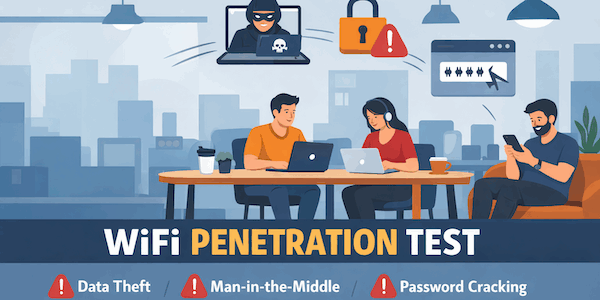
A WiFi Penetration Test is a specialized security assessment that focuses on the wireless entry points of your organization. Unlike a standard network test that looks at servers and software, a WiFi pentest evaluates the radio frequencies and 802.11 protocols that allow devices to connect to your network without a wire.
The goal is to identify if an attacker sitting in a car in your parking lot—or a café across the street—can bypass your physical security and gain access to your digital assets through the air.
It’s Not Just Testing an IP Address
When people think of a network pentest, they imagine a consultant pinging servers and scanning IP addresses remotely. However, a true WiFi pentest has nothing to do with IP addresses initially.
Because it involves physical radio waves, it cannot be done remotely. A consultant must be onsite at the customer’s premises with specialized hardware (like high-gain antennas and wireless adapters) to “sniff” the air. If you aren’t physically there, you aren’t actually testing the WiFi; you’re just testing the network behind the WiFi.
Critical Security Risks: From the Air to Your Backend
WiFi isn’t just a convenience; it’s a wide-open doorway if not configured correctly. Here are the top critical issues uncovered during a professional assessment:
-
Lack of Network Segmentation: One of the biggest risks is a “flat” network. If an attacker cracks your WiFi, can they move through your network to reach your backend servers or RDS database? A secure setup must ensure the WiFi is strictly isolated from critical infrastructure.
-
No Peer-to-Peer Isolation: If you are on a guest WiFi and can “see” other people’s laptops in your “Network” folder, you have no isolation. Attackers use this to move laterally between connected devices, stealing session cookies or spreading malware to everyone else on the same signal.
-
Packet Sniffing & Traffic Visibility: Without proper encryption and isolation, an attacker on the same WiFi can “sniff” the airwaves to see exactly what you are doing—capturing login credentials or sensitive emails in real-time.
-
The “Evil Twin” in High Footfall Areas: In busy locations, attackers broadcast a signal with the same name as your office WiFi. Because devices automatically hop onto the strongest signal, your employees might connect to a hacker’s “Twin” without knowing, giving the attacker total visibility over their traffic.
Common WiFi Attacks to Watch For
Hackers use the “air” to bypass your expensive firewalls. Common methods include:
-
De-authentication Attacks: Forcing a user’s device to disconnect from the legitimate AP so it automatically reconnects to the attacker’s fake one.
-
Handshake Capturing: Stealing the “secret handshake” data sent when a device joins the network to crack the password offline.
-
Rogue Access Points: Secretly plugging a cheap router into an office Ethernet wall jack to create a “backdoor” that bypasses all corporate security.
Why You Should Not Use PSK (Pre-Shared Keys)
Most offices use a PSK (Pre-Shared Key)—the “one-password-for-everyone” method. This is a massive security risk for businesses.
-
The “Ex-Employee” Risk: When someone leaves the company, they still have the keys. You would have to change the password for everyone and every device to stay safe.
-
Ease of Cracking: PSK handshakes are much easier to “capture and crack” than enterprise-grade logins (802.1X).
-
No Accountability: You cannot tell which specific person performed an action on the network because everyone shares the same identity.
Looking for a WiFi Pentest Vendor?
A professional WiFi pentest service goes beyond the IP. We physically walk your site to map signal leakage and ensure your data stays inside your four walls. Visit our page to find out more. If you are a Singapore SME, check out for CISOaaS VAPT Grant.